Hair Tissue Mineral Analysis (HTMA)
CONTACT OFFICE FOR DETAILS:
805.235.5011
naturalhealthybalance@gmail.com
Your mineral balance is important.
Choose the practitioner who co-wrote the book.
HTMA Practitioners ARE NOT Created Equal.
Before you work with any HTMA Practitioner, ask the 6Q’s:
HTMA has grown rapidly in popularity — and with it, the number of people calling themselves HTMA practitioners. Today, anyone can take an online course, order test kits, and start interpreting complex mineral patterns. There are currently no accredited HTMA educational programs and no standardized credentials required to practice. THIS MATTERS!
1. Do they have medical or clinical training? Not just a coaching certificate — real training in how the body works as a system.
2. How many hair analyses have they personally reviewed? There is no substitute for seeing thousands of real cases.
3. Do they understand mineral interrelationships beyond individual levels and basic ratios? If your practitioner sees low calcium and simply recommends calcium, they are missing the point of HTMA entirely.
4. Can they account for your medications and health conditions? If the answer is no, you are taking a risk.
5. Is the HTMA Lab that is used FDA Certified? Many reports are incomplete, covering only 8-10 minerals with no information about how high or low your minerals are and no information about mineral relationships.
6. Do they understand the Thompson-Dobereiner Principle?

Why have Mary Kay analyze your test?
As the co-author of Mineral Medicine: The Missing Elements that Change Everything, Mary Kay brings a depth of expertise that no certification course can replicate. Her 35 years of Integrated Health and direct clinical training with Dr. Robert Thompson since 2022 — and their shared work analyzing thousands of patient cases — gave her a mastery of the Thompson-Dobereiner Principle that exists nowhere else in HTMA practice.
Other practitioners can hand you a report. Mary Kay can build a precision protocol that works with your body's unique mineral pattern, not against it.
Your Body Isn't the Problem. Your Minerals Are.
You've been to the doctor. Your blood work came back "normal." But you still don't feel right — the fatigue, the brain fog, the weight that won't budge, the anxiety that came out of nowhere. Sound familiar?
Here's what most practitioners miss: blood tests are snapshots. They tell you what's circulating in your blood at the moment of the draw. Eat a banana before your test and your potassium looks fine — even if your tissues are starving for it. Urine tests? They measure what your body is throwing away, not what it's actually using.
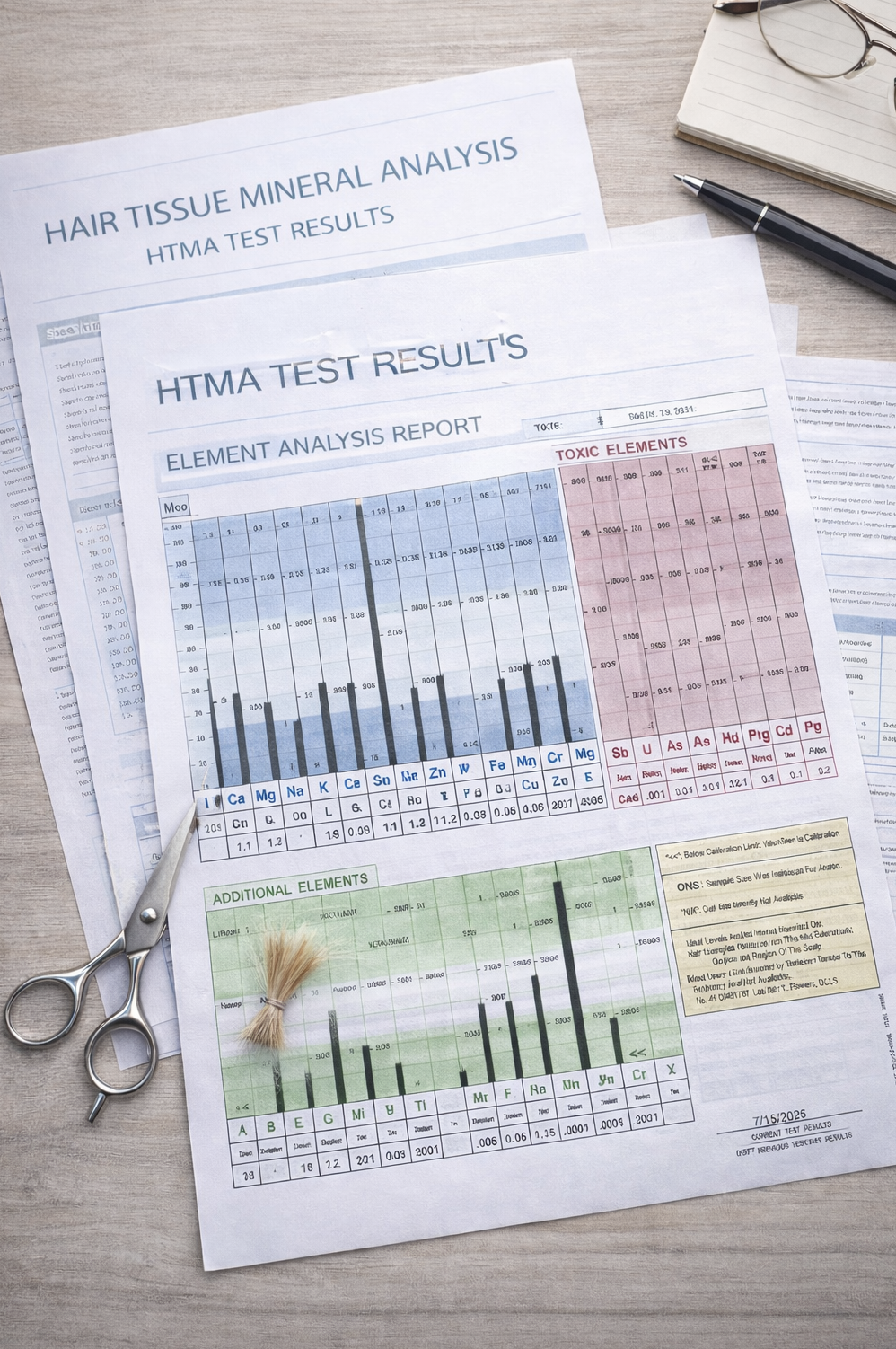
Hair Tissue Mineral Analysis is different. HTMA measures the minerals stored in your tissues over time — not a single frozen moment, but the full picture. Think of it this way: if blood and urine tests are photographs, HTMA is the video.
What HTMA Reveals
Your hair contains every mineral present in your body — nutritional minerals like calcium, magnesium, zinc, and potassium, as well as toxic heavy metals like mercury, lead, and arsenic. HTMA measures these levels and, more importantly, reveals the relationships between them.
This is where it gets powerful. HTMA doesn't just tell you what's high or low. It shows:
How efficiently your body is processing nutrients
Whether you're a Fast or Slow Metabolizer — and why that changes everything about what you should and shouldn't take
Which minerals are blocking others from doing their job
Whether toxic metals are accumulating in your tissues
The hidden imbalances driving your symptoms — even when you "feel fine"
Why Most Supplement Programs Fail
Taking the wrong vitamins and minerals — even "good" ones — can make you worse. HTMA tests support anyone taking supplements and wanting to make sure they're taking the right ones
Too much zinc? It antagonizes vitamin D.
Too little vitamin D? It blocks calcium absorption.
Too much calcium depletes potassium, which is the most important mineral for mitochondrial energy.
Too much copper can cause an increase and retention of zinc.
And many more combinations you need to know based on your precise chemistry.
This is why a generic multivitamin is a gamble. What helps one person can harm another. Your body has a unique mineral pattern, and supplementing without knowing that pattern means you risk creating the very imbalances you're trying to fix.
HTMA takes the guesswork out. It tells you exactly what to take, what to avoid, and why.
The Thompson-Dobereiner Principle: What Sets Us Apart
There are practitioners across the country offering HTMA testing. But here's what they don't have: the Thompson-Dobereiner Principle.
Developed by Robert Thompson, MD, this groundbreaking theory explains how minerals operate in triads — interconnected groups of three that influence each other in predictable, measurable ways. Understanding these triads changes everything about how HTMA results are interpreted and how treatment protocols are designed.
Dr. Thompson performed over 5,000 hair tissue mineral analyses on patients throughout his career, refining and validating this principle through real clinical outcomes. His work represents the most advanced framework for understanding mineral interrelationships in practice today.
Mary Kay is Dr. Thompson's co-author on Mineral Medicine: The Missing Elements that Change Everything — the definitive book on HTMA and the Thompson-Dobereiner Principle. She trained directly with Dr. Thompson for three years, mastering the clinical interpretation of HTMA results through this lens. Together, they documented thousands of patient cases that demonstrate how mineral triads drive health and disease.
You don't have to be sick to benefit from HTMA. THIS IS PREVENTATIVE WELLNESS. This test is for anyone who wants to understand what their body actually needs — not what a generic recommendation says they should take.
HTMA is used by:
People struggling with chronic symptoms their doctors can't explain
Anyone dealing with fatigue, weight issues, anxiety, brain fog, or hormonal imbalances
People concerned about toxic metal exposure. We will recommend and additional chelation test if it shows positive.
Athletes and high performers looking to optimize their nutrition
Parents who want to understand their children's nutritional needs
Anyone taking supplements and wanting to make sure they're taking the right ones
People who feel fine but want to catch imbalances before symptoms develop
World-class athletes, heads of government, and performers whose careers depend on peak physical function all use HTMA. It's appropriate for every age — from infants to octogenarians — and every level of health.
What You Might Not Expect from Your Results
HTMA results often surprise people. Here are some things that catch patients off guard — and why they matter:
"My mineral levels are high even though I don't eat those foods." Diet is only part of the picture. Your glandular activity and metabolic type drive mineral retention just as much as what you eat. Someone on a low-sodium diet can show high sodium because their adrenals are overactive. Someone eating plenty of salt can show low sodium because their adrenal activity is weak. HTMA connects the dots between your metabolism, your glands, and your mineral levels.
"I feel perfectly fine, but my results show imbalances." This is more common than you'd think. Your body compensates for imbalances — sometimes for years — before symptoms appear. HTMA catches what your body is silently managing, giving you the chance to correct it before it becomes a problem.
"A mineral that's low on my test wasn't recommended in my supplement plan." That's the Thompson-Dobereiner Principle at work. Supplement recommendations are based on your overall mineral pattern, not individual levels in isolation. Sometimes the fastest way to raise a low mineral isn't to take more of it — it's to reduce the mineral that's blocking its absorption. A low calcium level, for instance, might be corrected by adding copper, which improves calcium retention. This kind of precision is what separates expert HTMA interpretation from basic report reading.
"A mineral that's high on my test was still recommended." Context matters. A mineral can test high but still be low relative to another mineral — creating what's called a relative deficiency. Magnesium might look elevated, but if calcium is even higher, the magnesium-to-calcium ratio is off, and magnesium supplementation may be exactly what's needed. Ratios matter as much as individual levels.
The Balancing Process: What to Expect
Correcting mineral imbalances is not an overnight fix. Think of it like peeling an onion — as the surface layers are corrected, deeper imbalances that were previously hidden may emerge. This is normal and expected. It's actually a sign of progress.
How quickly you respond depends on several factors: how long the imbalances have existed, how chronic or severe they are, and how closely you follow the recommendations. Some people notice changes within weeks. Others require patience as their body works through layers of stored imbalance.
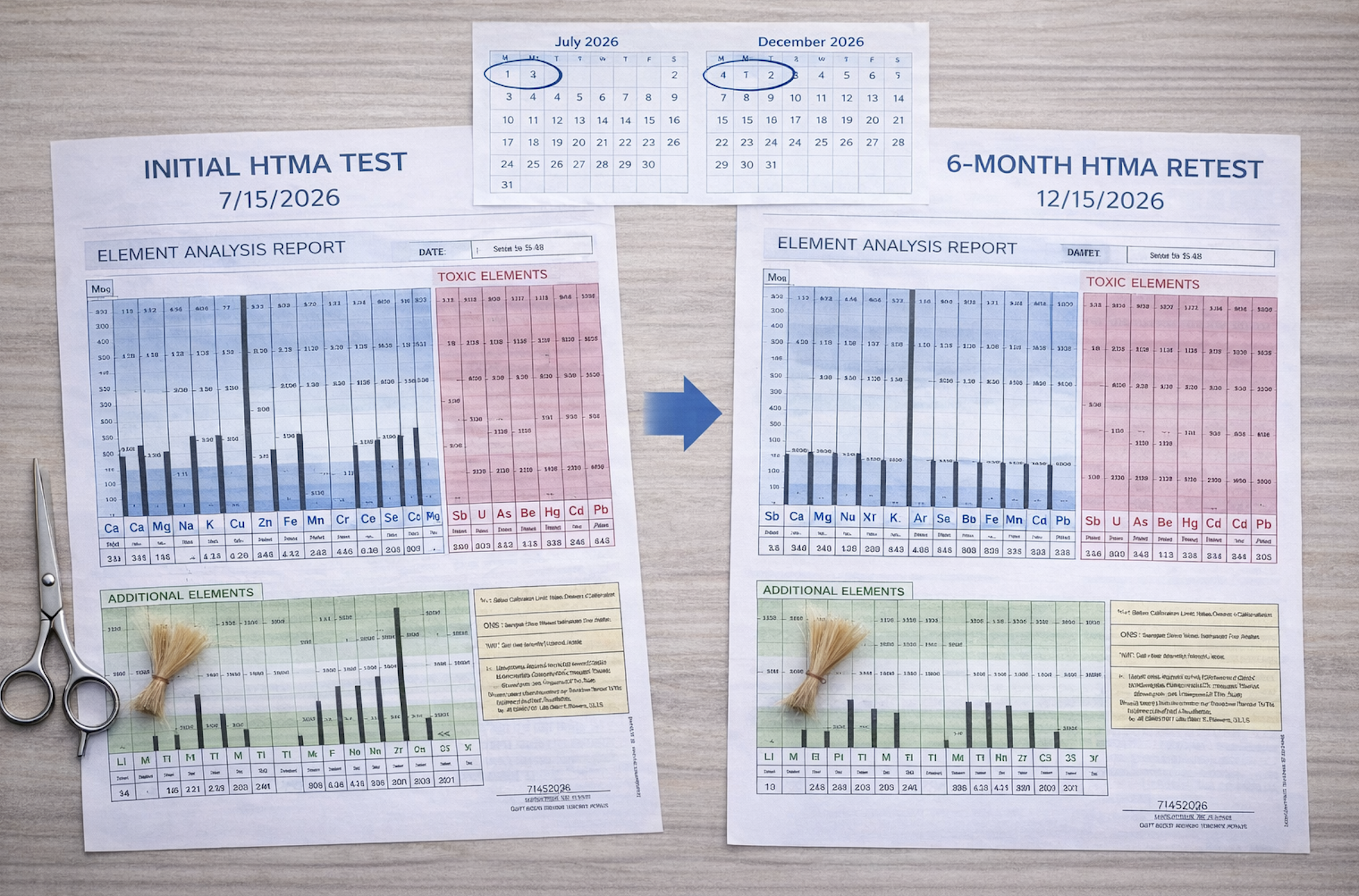
The key is follow-up testing. Your mineral pattern is not static — it shifts as your body heals, as your diet changes, as life happens. Stress, medications, environmental exposures, and even the seasons affect your mineral balance.
Follow-up HTMA testing every six months is recommended to:
Track your progress and confirm your body is moving toward balance
Catch newly emerging imbalances as deeper layers surface
Adjust your supplement protocol to match your body's changing needs
Ensure you're not over-supplementing now that the original imbalances have shifted
You are a dynamic, changing being. Your mineral program should change with you.
The Research Behind HTMA
HTMA is not fringe science. It is backed by decades of peer-reviewed research.
Research programs studying trace element concentrations in human hair have been running since 1965, coordinated by the International Atomic Energy Agency. Well over a thousand peer-reviewed references document and support the reliability of hair mineral analysis. Contributors to this body of research include the Cleveland Clinic, Mayo Medical School, Emory University, McGill University, CDC Atlanta, the University of Rochester, New York University, and dozens of other major institutions and research centers worldwide.